
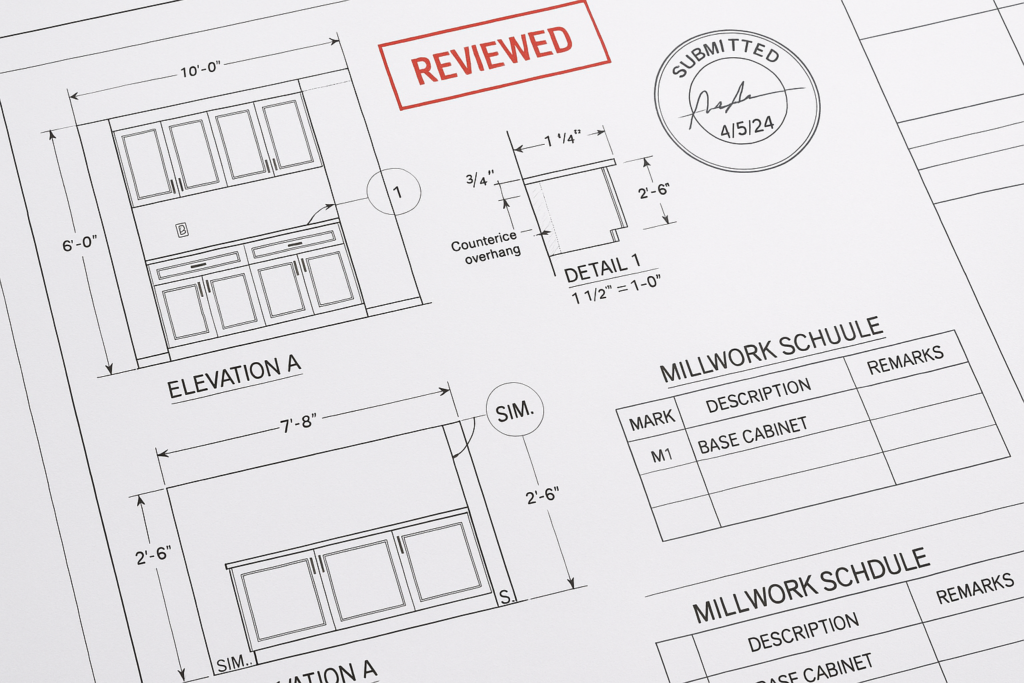
What GCs and architects need to know about submittal drawings
Submittal drawings matter before fabrication because they are the last practical checkpoint between design intent and built millwork. For general contractors, architects, project managers, and millwork shops, well-prepared millwork shop drawings reduce costly errors, clarify dimensions, confirm materials and finishes, and help everyone approve the same scope before production starts. In short, submittal drawings turn assumptions into coordinated instructions. If they are vague, incomplete, or inconsistent with the contract documents, fabrication delays, RFIs, field conflicts, and change orders become much more likely.
In architectural millwork, this review step is not just administrative. It directly affects lead times, installation sequencing, and final quality. Whether you are reviewing reception desks, casework, wall paneling, banquettes, display fixtures, or custom built-ins, the quality of the submittal package often determines whether fabrication moves smoothly or stalls in revision loops.
Why submittal drawings matter before fabrication
Submittal drawings exist to confirm what will actually be built. Architectural plans may show intent, layout, and performance requirements, but they do not always capture every fabrication-level condition. That gap is where architectural shop drawings and millwork submittals become essential.
Before fabrication begins, submittal drawings should verify:
- Overall dimensions and critical clearances
- Material selections, species, cores, veneers, laminates, and edge details
- Finish requirements and visual expectations
- Hardware locations and functional operation
- Interface points with walls, ceilings, flooring, MEP, and adjacent trades
- Installation assumptions and field verification notes
- Any deviations, exclusions, or unresolved conditions requiring approval
That is why they matter before fabrication: once material is cut, edge-banded, machined, or finished, corrections become slower and more expensive. A careful submittal review is far cheaper than remaking a run of cabinets or modifying paneling in the field.
A practical example
Imagine a lobby reception desk shown in design drawings at a conceptual level. The plans indicate the footprint and finish intent, but the submittal phase must clarify details such as transaction counter height, ADA knee clearance, stone overhang support, power/data cutouts, seam locations, reveal spacing, and how the desk aligns with flooring transitions. Without those details in the millwork shop drawings, fabrication can proceed on incorrect assumptions even when everyone believes the design is already approved.
How submittal drawings affect millwork shop drawings and architectural shop drawings
The terms are sometimes used loosely, but the function is consistent: submittal drawings are the review package submitted for approval, and millwork shop drawings are the fabrication-focused documents that communicate how custom millwork will be built. In many projects, the shop drawing set is the core of the submittal.
For architectural millwork, a strong submittal package usually includes more than elevation views. It should translate the design set into fabrication-ready logic. That means dimensions need to be traceable, sections need to explain construction, and notes need to communicate materials and coordination requirements clearly.
What a good millwork submittal should do
- Reflect contract documents accurately
- Show enough detail for design review and fabrication planning
- Identify items requiring field verification
- Flag discrepancies instead of burying them
- Coordinate visible aesthetics with practical construction methods
- Support procurement, production, and installation sequencing
When submittal drawings are weak, everyone loses time. Architects spend longer redlining unclear sheets. GCs chase responses because review comments trigger another incomplete round. Millwork shops waste effort revising avoidable omissions. Project managers struggle to keep release dates on track.
That is where disciplined millwork drafting becomes valuable. A clean, coordinated shop drawing package helps reviewers answer the real question quickly: can this be approved for fabrication as shown, or does it still contain unresolved risk?
What GCs, architects, and millwork shops should check before approval
Different stakeholders look for different things in submittal drawings, but the review should always focus on constructability, coordination, and clarity. The goal is not to mark up every graphic preference. The goal is to catch issues that will affect fabrication, installation, appearance, compliance, or schedule.
Checklist for general contractors
- Do the drawings match the approved scope and bid assumptions?
- Are dimensions coordinated with field conditions, not just design intent?
- Are long-lead materials, hardware, and finish selections identified?
- Do installation notes align with site sequencing and access constraints?
- Are trade coordination items called out clearly, including blocking, power, plumbing, and tolerances?
- Are exclusions or deferred decisions clearly noted?
Checklist for architects and designers
- Does the submittal preserve the design intent, proportions, and alignments?
- Are reveals, joints, grain direction, and finish transitions shown where appearance matters?
- Do sections explain edge conditions, returns, fillers, scribes, and shadow lines?
- Are substitutions or deviations clearly identified for review?
- Are code-sensitive items like ADA clearances or safety glazing addressed where required?
- Are there any conflicts between schedules, plans, elevations, and details?
Checklist for millwork shops and project managers
- Is every item dimensioned enough for fabrication and assembly?
- Are component relationships logical and buildable?
- Have field dimensions been confirmed or clearly marked as pending?
- Are hardware specs, cutouts, and backing requirements shown?
- Are panel break locations, seams, and material yields practical?
- Are revision clouds, dates, and resubmittal notes easy to follow?
What should be included in millwork shop drawings
Not every project requires the same level of detail, but complete millwork submittals typically include the core information needed for review and eventual fabrication release.
Typical drawing content
- Cover sheet with project, drawing index, revision history, and submittal status
- Plans, elevations, and sections for each millwork item or assembly
- Key dimensions, including overall sizes and critical interior clearances
- Material callouts and finish references
- Construction notes, edge details, and attachment concepts
- Hardware references and accessory coordination
- Item tags matching schedules or room references
- Coordination notes for field verification and adjacent trades
When more detail is needed
Complex custom pieces often need enlarged details, 3D views, or component breakdowns. Examples include curved reception desks, integrated lighting reveals, back-painted glass inserts, specialty veneer matching, or concealed access panels. In these cases, a minimal submittal invites misunderstandings. The more custom the item, the more important drawing clarity becomes.
Common mistakes and approval delays to avoid
Most submittal delays are not caused by one dramatic error. They usually come from a pattern of small omissions that force reviewers to keep asking basic questions. If your team wants faster approvals, these are the issues to eliminate early.
1. Missing dimensions
Sheets that rely too heavily on scaled views or partial dimensions create uncertainty. Reviewers should not have to guess the depth of a cabinet bank, the width of fillers, or the location of a hardware centerline.
2. Poor coordination with architectural backgrounds
Millwork that fits perfectly on paper can fail in the field if wall thicknesses, column offsets, soffits, flooring buildup, or existing conditions are not coordinated. This is especially common in renovations and hospitality work.
3. Unclear material and finish callouts
“Wood finish per design” is not enough if multiple finishes exist in the project. Ambiguous finish labeling slows approvals and increases the risk of fabrication based on outdated assumptions.
4. No visible distinction between standard and revised information
When resubmittals are not clearly clouded or tracked, reviewers waste time comparing entire sheets to find changes. Clean revision control is a practical way to speed up review cycles.
5. Hiding deviations in notes
If the fabrication approach differs from the design documents, that needs to be obvious. Buried notes create avoidable conflict later when someone assumes the item was approved as designed rather than as modified.
6. Submitting too early or too late
A premature submittal often lacks field information and coordinated selections. A late submittal compresses review time and increases approval pressure. The right timing is when the package is detailed enough to review meaningfully but early enough to protect procurement and fabrication dates.
How to make submittal review faster and more useful
Better review cycles start with better drawing structure. GCs and architects do not need more sheets for the sake of volume. They need sheets that answer likely questions the first time.
Best practices for cleaner approvals
- Use consistent item tagging that matches schedules and room names
- Show critical sections at the locations where decisions actually happen
- Call out pending field verification clearly and specifically
- Separate design notes from fabrication notes when needed
- Identify alternates, substitutions, and exclusions directly on the sheet
- Keep revision history transparent between submittal rounds
A practical review process also helps. If the architect is reviewing design conformance, the GC is reviewing scope and coordination, and the millwork shop is preparing fabrication release drawings, each party should know what they are responsible for commenting on. That reduces circular markups and duplicate requests.
Where MillworkIQ fits in
Many teams do not need a theoretical explanation of submittal drawings. They need a practical way to produce accurate, reviewable, coordinated drawing packages on schedule. That is where MillworkIQ fits naturally.
MillworkIQ supports millwork shops, contractors, and project teams with drafting, redline cleanup, revision management, dimensions, schedules, and coordination notes tailored to architectural millwork. If your current package is too rough for approval, too cluttered for efficient review, or too incomplete for fabrication confidence, MillworkIQ can help turn it into a cleaner submittal set.
For teams that need outside drafting capacity or submittal support, MillworkIQ’s services are directly aligned with shop drawing production and review workflows.
Examples of when outside support makes sense
- Your internal drafters are overloaded and release dates are slipping
- An architect returned extensive redlines and the resubmittal needs cleanup
- The project has many custom items that need more detailed sections and notes
- You need drawing consistency across multiple packages or phases
- The GC needs clearer coordination information before approving fabrication
Instead of letting submittals become a bottleneck, teams can use MillworkIQ to improve clarity before another review cycle is wasted. If you want to see the level of detail and presentation style, the portfolio gives a relevant view of drawing output for architectural millwork.
Quick decision guide: is your submittal ready?
Use this short test before sending a package for review:
- Can a reviewer understand exactly what is being built without guessing?
- Are the most important dimensions visible on the right sheets?
- Are materials, finishes, and hardware coordinated and labeled?
- Are all known deviations from design documents easy to spot?
- Have field verification items been identified clearly?
- Would your fabrication team be comfortable planning from this package after approval?
If the answer to several of these is no, the drawings likely need another pass before submittal.
FAQ
What is the difference between submittal drawings and millwork shop drawings?
Submittal drawings are the documents sent for review and approval. In millwork, the shop drawing set is often the main part of that submittal. Shop drawings focus on dimensions, construction, materials, and coordination needed to build the item.
Why are millwork shop drawings so important before fabrication?
They confirm design intent, fabrication assumptions, field coordination, and visible finish details before materials are ordered or cut. That reduces rework, delays, and installation conflicts.
Who should review millwork submittals?
Typically the millwork shop prepares them, the GC reviews them for scope and coordination, and the architect or designer reviews them for design conformance. Project managers may also review schedule and procurement impacts.
What causes the biggest delays in approval?
Common causes include missing dimensions, unclear finishes, poor revision tracking, uncoordinated field conditions, and deviations that are not clearly identified.
Can MillworkIQ help with redline revisions and submittal cleanup?
Yes. MillworkIQ is well positioned to support drafting, redline incorporation, drawing cleanup, dimensioning, schedule coordination, and preparing clearer millwork submittals for review.
Final takeaway
Submittal drawings are not a formality. In architectural millwork, they are the control point that helps protect design intent, schedule, cost, and fabrication accuracy before production begins. Strong millwork shop drawings make approvals easier because they replace assumptions with coordinated detail.
If your team needs help drafting shop drawings, cleaning up redlines, or strengthening a submittal package before the next review cycle, request a quote from MillworkIQ. “Clear drawings create faster decisions, and faster decisions keep fabrication moving.”